
Posts Tagged ‘injury prevention’

Dynamic Mobility: Reduce Injury & Make The Most From Your Workouts!

Saturday, February 27th, 2010

Fascia

What is it?

Dynamic mobility is a great warm up before training. Although there is a bit of semantic confusion in the phraseology, I am referring to “mobility” as contracting your muscles and taking your joints through their ranges of motion actively, as opposed to passively.

What does it do?

  • Increase flexibility
  • Prevent injury
  • Enhance performance
  • Make the most out of your exercises

How does it work?

More and more research has been showing that static stretching before workouts is not the optimal time to do this. When you, say, lay on your back and stay in a stretch for a minute or more, then switch positions and lay down some more and hold it for another minute, and so forth…do you think your nervous system is firing up? Actually, the opposite occurs, and the signal between your muscles and your nervous system weakens, which can result in reduced strength and power output, and less coordination within your body, which can lead to injuries!

When you warm up by actively moving your joints and muscles through their ranges of motion, you are stimulating your nervous system and enhancing the signal between it and the muscles. This leads to an increased power and strength output, greater joint range of motion, and a much more efficient performance. You also get the synovial fluid (fluid in your joints that helps cushions and lubricate) going in your joints, greatly reducing joint friction. Now your body is warm and your joints are ready for exercise!

AFTER working out then, you can perform your static stretching, and by doing so, you will relax your system and prime your body for recovery.

What do I do?

Begin with about 5-7 minutes of continuous moving activity to raise body temperature, increase blood flow to your muscles, and activate your nervous system. Any sort of cardio will do, such as biking, a light jog, or elliptical. Once you have completed your light cardio, continue with dynamic mobility, then your workout (e.g. resistance training), then do static stretching.

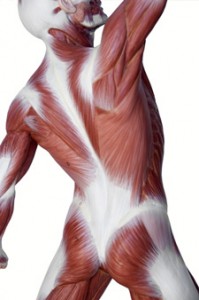
Even if you are just doing “legs” you still need to work on TOTAL BODY mobility. Question: If you pull one section of a spider web, does the whole rest of it remain intact? No! The whole thing will shift. This is the same in your body, due to your fascia, which is an amazing three-dimensional soft-tissue network in your body. If your shoulder girdle is tight, for example, you will not generate the same fluid arm swing you need in running, and this has ripple-down effect to your hips, knees, and ankles. Therefore, understand that tightness in one section of the chain can impact a body part much further away (e.g. arch of the foot can impact the back!) SO, work on total body mobility and watch the positive cumulative effect unfold after a few weeks.

SAMPLE DYNAMIC MOBILITY PROGRAM

Perform each exercise for 6 -10 reps each, in a smooth, continuous manner. Start with smaller and slower ranges of motion and progress over time in amplitude and speed. Note that anatomical distinctions (below) are loose.

Upper Body:

  • Arm swings
    • Overhead/down and back
    • Side/front crossover
  • Forearm stretch
  • Wall slides

Neck:

  • Flexion/extension
  • Lateral flexion
  • Rotation (look R, L)

Trunk and Shoulder Girdle:

  • Flexion/extension
  • Lateral flexion
  • Rotation (hands up, elbows out)
  • Inchworm
  • Knees to Chest
  • SL RDL
  • Bird Dog

Lower Body:

  • Hip circles
  • Hip twists
  • Leg Swings
    • Flexion/extension
    • Cross body flexion/abduction
  • Frankensteins
  • Quad stretch
  • Sumo Squat to Stand
  • Reverse Lunge to Twist
  • Spiderman
  • Scorpion
  • Ankle Bounce
    • Double leg
    • Single leg

I hope to post some video soon. For now, I hope you appreciate the message that we need optimal length-tension relationships in our entire kinetic chain to build our athletic base and prevent injuries. Please feel free to comment or email me if you have any thoughts or questions :)

Week SIX of Thirteen to kicking ass and taking names…

Saturday, February 20th, 2010

The injury rehab process has been…less than pleasant.

frustrated

Let me think of some things I would rather do than go without my sweaty, fantastically killer workouts

  • eat cockroaches (have already done that, actually, but I digress)
  • have someone burn my flesh (check! still have the marks, what can you say, we were crazy kids)
  • go without my beloved many flavors of protein powder
  • the list could go on and on

My adherence to the program has been a bit spotty lately. Have not been as frequent with my rehab “workouts.” Have not iced. Have not done towel scrunching. Have not taken any group exercise classes, as I had planned, because I feel reluctant to relinquish control to an instructor and would rather be in control of my own exercise. I HAVE been diligent about rolling and stretching my foot, doing single leg balance exercises and tube walking to strengthen the arch, glute medius, and other lower limb infrastructure. I have been doing a montage of my rehab exercises for knee and shoulder (as tolerated), and I have been increasing my jogging mileage (woo hoo!).

Today marks week 6, which is a huge lifesaver for me, because I get to move to my strength cycle, and I LOVE strength training! I get to switch my routine a bit, and already the workout this morning was much more invigorating!

HappyCat

I allowed myself to do whatever I wanted in the gym (within limits) and had a great time testing out my (measly) strength. Wow, what a difference! My left latissimus dorsi and posterior deltoid are weaklings! About two months ago I was popping out 3 set of 15 bodyweight pull ups no problemo (and sometimes even weighted pull ups) and having people come up to me at the gym asking how do I do that, and today…well…today I was struggling to do ONE! What a far cry! And the seated row, and the push ups, and the lunges…I marveled at how my strength has waned in only two months! I am certain, though, that as long as I progress CAUTIOUSLY, I will be back at my previous strength pretty soon.

I will stay in this strength phase for four weeks before I progress to power. At least, that’s the plan.

Here is my outline:

Week 6-9: Strength

Focus: increase the load-bearing capabilities of muscles, tendons, ligaments, and joints

Massage WEEKLY this cycle  (I am blessed to start a trade with a massage therapist, yes!)

Healthy fats (e.g. chia seeds or olive oil) & healthy nutritional choices daily

Wellness Visualization x1/day

Incorporating total body exercises, including:

Shoulder:

8-12 reps, 3-4 sets, minimal rest

DB OH press

DB bent arm lateral raise

DB I, T, Y

Foam roll: Lats

Stretch: Pendulum, posterior capsule stretch, external rotation, internal rotation, lats, pecs, biceps, supraspinatus, neck

Foot: Roll bottom of foot w/tennis ball

Knee:

8-12 reps, 4 sets

DB lunge matrix

Multi-planar step ups

Step downs

Foam roll: quads, IT band, adductors, piriformis, calves

Stretch: glutes, quads, hip flexors, piriformis, adductors, achilles

Cardio: Try jogging 30 min a day, 3 x wk (to be increased by 5 min weekly)

~Each week I will increase the resistance training load, reps, complexity, plane of motion, or other variable to slowly and progressively overload my muscles.

Will keep you posted on my progress.

Lots of love to you all**  <3 <3 <3

Week 3 of Injury Rehab update

Saturday, February 6th, 2010

Today marks the end of week 3 of my 13 week program to healthy, lean and mean goodness. This past week I have been dealing with a cold, so have not been working out much…This week I jogged twice for 15 min as opposed to three times this week, and did shoulder rehab twice and knee rehab once instead of twice…I have not been icing…but have been stretching and all that good stuff. Knees and foot feel good, shoulder feels eh.

Sucks to not work out. Sucks to have a cold. But must stay in positive spirits, eye on the prize.

Happy Saturday to everyone!

ACL injury prevention & multi-planar training

Monday, February 1st, 2010

Something I feel very passionate about is multi-planar training. Ever since I tore my ACL a year and a half ago, learned more about principles of rehabilitation and injury prevention, and got certified as a Corrective Exercise Specialist, I have a message about training: Thou must train in multiple planes of motion. Most people (especially endurance athletes) overtrain in the sagittal plane (front and back). This leads to overuse injuries as well as weakness and instability when a demand from the frontal (side) or transverse (rotational) plane challenges them. Which happens frequently, because we don’t move only front and back- we step to the side, we twist, we cross our legs over, et cetera. If we move in multiple planes, we need to train in multiple planes.

What is multi-planar training? Multi-planar training means training in all planes of motion.

What are the planes of motion?

  • The sagittal plane means to the front and to the back. Examples: walking, running, biking, seated row, bicep curl, push ups.
  • The frontal (or coronal) plane means to the sides (confusingly enough). Examples: side shuffles, jumping jacks, lat pull down, lateral raises.
  • The transverse plane means rotation. Examples: Russian twists, cable woodchops, lunge w/med ball twist, golf swing.

Body Planes

ACL injury prevention and multi-planar training

Mike Boyle, one of the top strength and conditioning experts around and owner of the #1 Strength and Conditioning Facility in the nation (2009) as voted by Men’s Health, wrote a very interesting article on ACL injury prevention. Read it here: http://www.strengthcoach.com/public/1641.cfm?sd=51

He agreed that increasing the eccentric control (a.k.a. deceleration) from multiple planes of motion is key to reducing the incidence of ACL injuries. He describes his program in total as:

- Active Warm-up
- Power and Stability / Eccentric Strength=landing skills
- Strength Development – (emphasis on 1 Leg)
- Change of Direction Concepts – learning how to stop
- Change of Direction Conditioning – developing conditioning

His unique assertion is that this program does not differ inherently from a good training program for any athlete. Any well-developed program should include the elements listed above. In essence, there is no such thing as an ACL injury prevention protocol. There is only good training (that would naturally include multi-planar training) and bad training.

How to modify exercises in different planes? Okay, so you would like to incorporate more multi-planar training into your workouts. How do you do that? All you have to do is understand the planes of motion, and tweak your exercises to follow the various planes. The number of exercises that can be created is ENDLESS. Use your creativity! Let’s run through some examples below.

Running: Traditionally this is done in the sagittal plane. How about doing some side shuffles, running backwards, diagonal bounding, or karaoke?
Push ups: Traditionally, this is also done in the sagittal plane. How about side to side push ups? Or push ups with rotation (a.k.a. T-push ups)? (e.g. push up, then raise one arm up and twist your body laterally toward the ceiling? Then rotate back to center and repeat on the other sids)
Lunges: Again, this is usually done in the sagittal plane. How about side lunges or rotational lunges, or a multi-planar lunge matrix?
Upper Body Pull: Such as a row. Traditionally done in the sagittal plane (are you catching a pattern here?). How about a lat pull down (a pull in the frontal plane), or an alternating row with torso rotation to challenge the transverse plane?
Step Up: Do I have to say it? Usually sagittal plane dominant. How about side step ups? Cross over step ups? Transverse step ups? (Always make sure the knee is aligned over the 2nd and 3rd toe)

Does this make sense? By challenging your body in different ways and training in the way that life and all sports HAPPEN (e.g. in ALL planes), you are doing yourself a favor by promoting major injury prevention. If you don’t already train like this, start now and let me know how it goes. If you already do, I hope I have reminded you of why what you’re doing is important and reinforce your commitment to functional/multi-planar program design.